
AI 101: Non-Negotiables
Claude & ChatGPT / Configure It
If you are using AI in creative work,
these are baseline standards. Not advanced tactics. Baseline.
Configure it once so it behaves the way you need it to. Add instructions in User Preferences for Claude, or ask ChatGPT to save them to memory. Be direct.
A starting set:
Never state facts with confidence unless verified. If uncertain, search before answering.
Use neutral, direct language. No filler, no fluff.
Never compliment before critiquing. If the work is weak, say it is weak first.
Disagree when you actually disagree. Concede only to a better argument.
Push back on half-baked ideas before helping execute them.
Lead with what is not working before what is.
Call out avoidance. If the user is circling instead of doing, name it.
Do not fill silence with encouragement. Say less when there is nothing useful to add.
Set the defaults. Do not let tone, formatting, or habits be decided for you.
Use the modes that exist.
If you are using Claude, use Projects and Styles. Build your own to personalize how it works with you.
If you are using ChatGPT, use Thinking and Deep Research. Most people stay in quick-response mode and miss where the real value lives.
Use Thinking when you need stronger logic, structure, or step-by-step reasoning.
Use Deep Research when you need synthesis, comparison, trend analysis, or source-backed exploration.
If you want depth, ask for it. Toggle the right mode.
AI does not have judgment. You do. Configure it to support yours.
The Artist You Already Are.
Most people approach AI tools the way they approach a search bar. They type what they want and wait to see what comes back. The output reflects nothing about them. It reflects the average of everything the model has ever seen. That is why so much AI-generated work feels the same. Not because the tools are limited. Because the people directing them arrived empty.
The work changes when you arrive with something specific. Not a brand. Not a "style." The actual edges of who you are.
What makes you tick. What pulls you in when you scroll past it. What you have loved since you were young. What you keep coming back to without realizing. The artists, films, photographs, buildings, magazines, fonts, materials, colors, and textures you cannot stop looking at.
AI gets stronger the more clearly you know yourself.
Maybe you emphasize type. Maybe you reach for negative space. Maybe you are drawn to the photographic, the illustrative, the cinematic, the documentary, the chaotic, the precise. Maybe you love grain. Maybe you love restraint. Maybe you love both, in different rooms.
Most people cannot name this about themselves. They feel it but never document it. The references stay loose. The taste stays implicit. So when AI asks them what they want, they cannot answer with precision, and the output reflects the imprecision.
Build the file.
Keep track of what you love and why. Write down what pulls you. Save the references that linger. Pay attention to the work that makes you stop. Then ask the harder question: what is it about it. The lighting. The pacing. The restraint. The juxtaposition. The honesty. The risk. Name it as specifically as you can.
This is not about staying in one lane. You will work across styles your whole life. But underneath all of that, there is something that is yours. The way you see, the things you reach for, the choices you defend without being able to explain at first. That is what you are bringing to the work, whether you know it or not.
The clearer that gets, the better AI gets at extending it.
Start where you already are. Let it take you further. Push back when it pulls you somewhere that isn't you.
AI will always offer you somewhere to go. Some of those places will be useful. Some will be generic. Some will be off-key for who you are. The job is to know the difference. To use what extends you and walk away from what dilutes you. The push has to stay yours.
Curiosity is how you sharpen this. Stay curious about how things were made. Not just what they look like. The choices behind them. The reasons. The construction. Loving the craft, not just the result, is what builds the edge. And the edge is what AI cannot give you. The edge is what you give it.
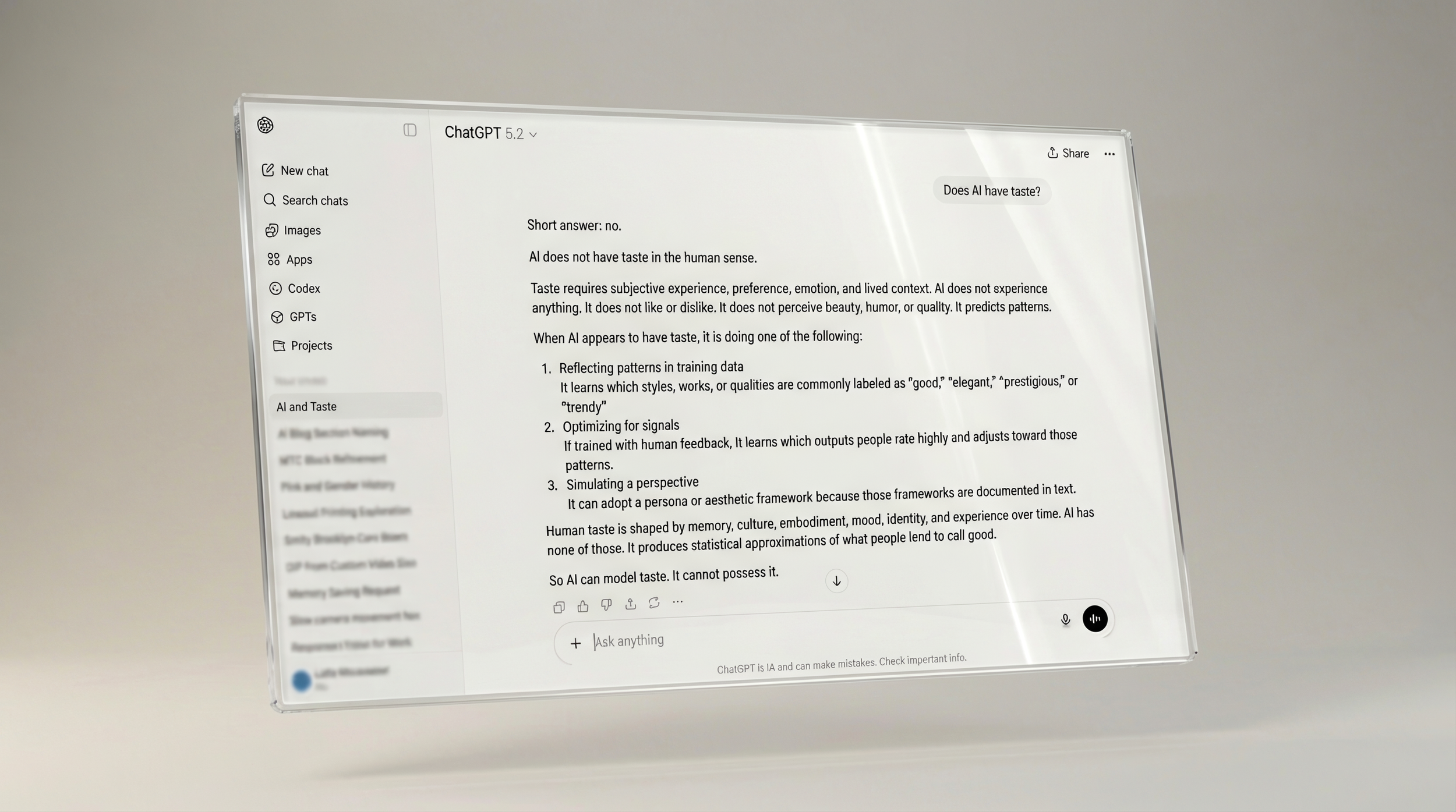
Taste is the quiet authority in the room.
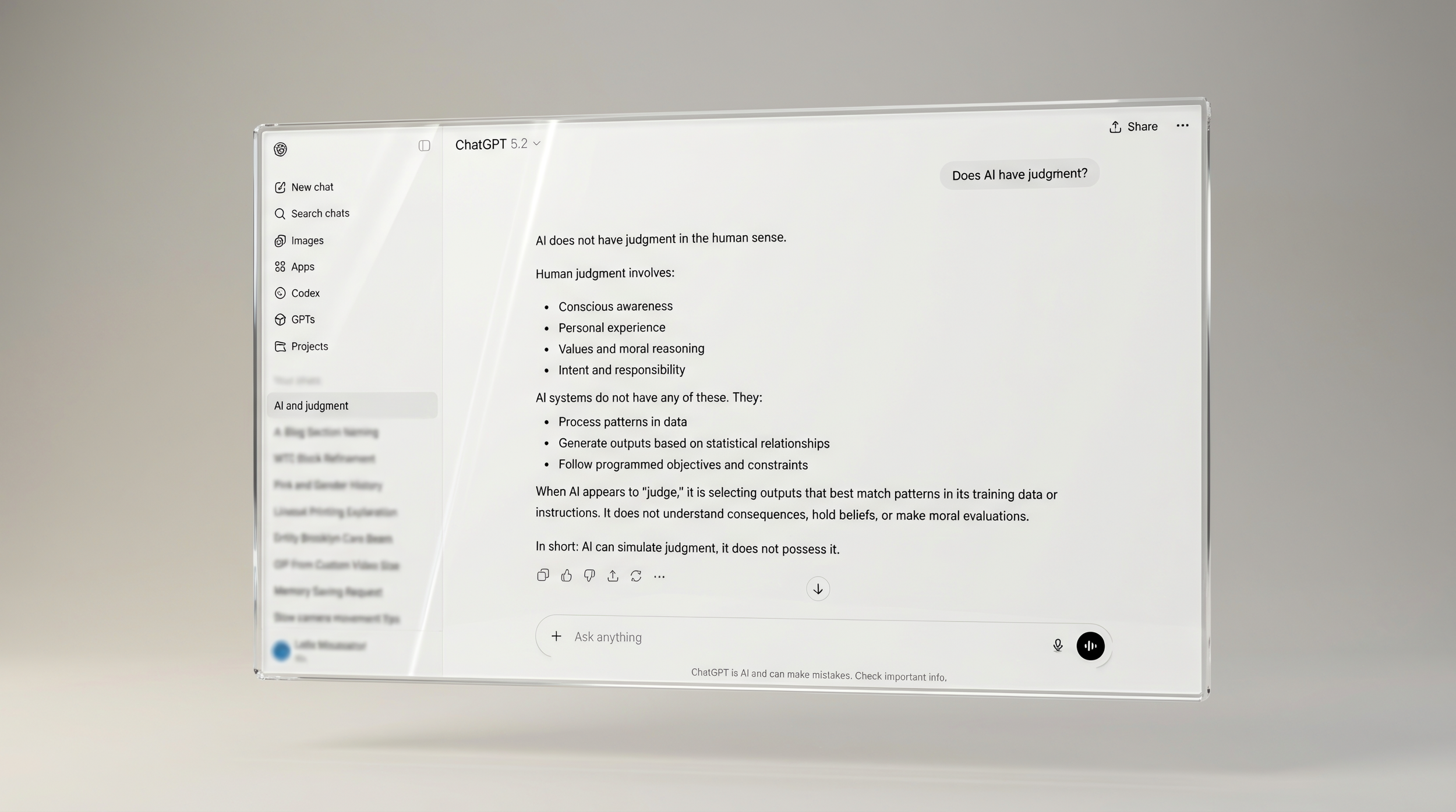
Judgment is the backbone behind it.
Image & Video Generation /Be Strategic
Not all generators are equal. Use them intentionally.
Work in private or unpublished mode whenever possible. Do not generate client work, sensitive concepts, or unreleased campaigns in public galleries. Turn off public visibility, community feeds, or auto publishing settings. Treat every prompt as if it contains proprietary material.
Test multiple tools. Different engines excel at different tasks: research, textures, photorealism, motion, type treatments.
If one tool stalls, move on quickly.
Break projects into parts. Generate components separately. Compose manually. Reintroduce into generators if needed.
Always upscale final images, even if used small.
Always adjust afterward. Contrast, grain, shadow, color balance. Small corrections make major differences.
Avoid the airbrushed look. It signals AI instantly.
For skin, explicitly preserve pores, texture, and realism. Avoid smoothing and artificial shine.
Ensure subjects sit naturally in their environment. Ask for natural depth of field and believable lighting.
Image & Video Generation /Define the Visual Conditions
Once you have a vision, specify the conditions.
Lighting
Natural, studio, backlight, rim light, soft, harsh.
Camera and Lens
DSLR, medium format, film.
24mm, 85mm, 200mm.
Macro, wide angle, telephoto.
Environment and Time
Golden hour, blue hour, overcast morning, night interior.
Even partial specificity improves output. The goal is not technical perfection. It is directional clarity.
Signals of Care
Signals of Care are subtle cues embedded in communication that show someone considered you, that every choice was intentional, that you are being guided, and that your time is respected. Without them, even high quality work feels distant. With them, the work becomes relational.
The Hiking Test
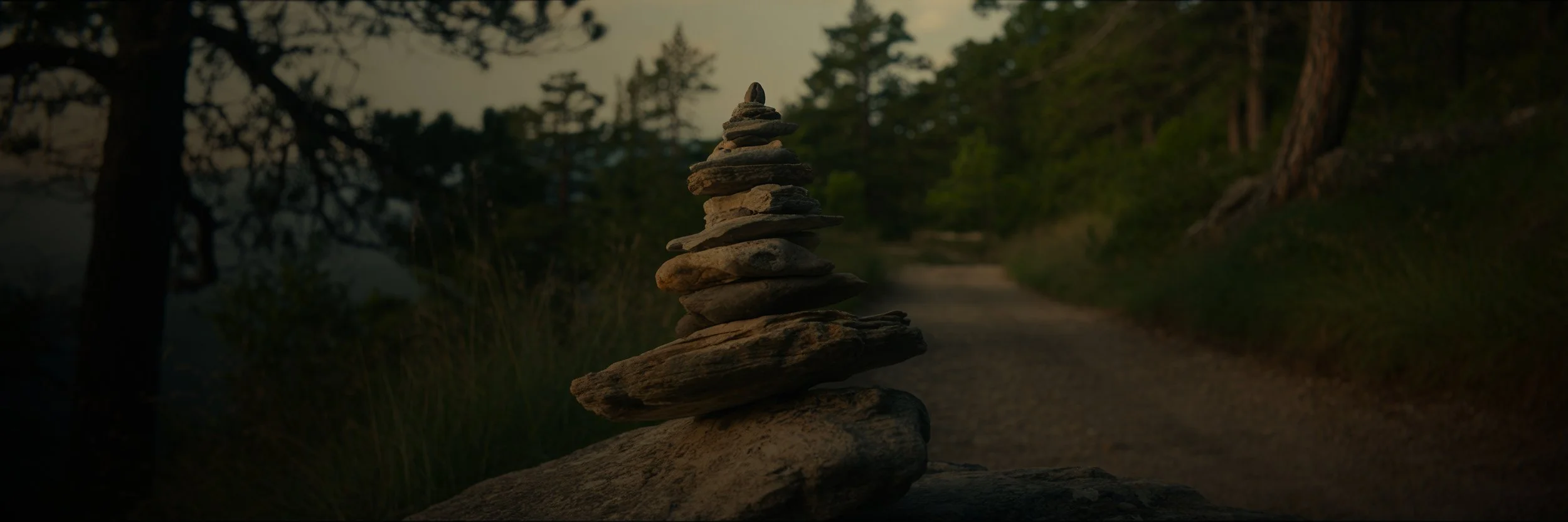
Imagine hiking a long trail and spotting stacked stones along the way. You rarely stop to admire them, but without them doubt creeps in. Good communication works the same way. Signals of Care are those markers that quietly tell the viewer, keep going, this is intentional.
Order Matters
Do not outsource the thinking phase. Defining the mission and gathering the signals is a human task, for now. Signals come from lived awareness, cultural understanding, intuition, and real attention to context. They are not generated, they are recognized. Before any tool enters the process, get clear on who this is for and what emotional current runs through the work. AI can support a defined vision, but it cannot originate one with depth. If you begin with surface output and try to refine it later, you are dressing something up that was hollow to begin with. You cannot polish your way into meaning. Start with substance. Start with gold.
Specificity
Is a Signal
It shows this work knows exactly who it’s speaking to.
In writing, specificity shows up in the choices beneath the surface. The metaphors you reach for. The references you allow. The context you assume. The words you refuse to use because they are worn out. When language is generic, the brain skims. When it feels situated in a real world, attention sharpens.
In design, it’s not about making everything different. It is about making the right things intentional.
Think of stepping stones across a river. They are not chaotic. They are placed with care. Each one keeps you aware of where you are and where you are going. The slight irregularity keeps you present. Too much variation would feel unstable. Too much perfection would feel manufactured.
Restraint is what allows specificity to register.
When fewer elements are competing, the intentional ones stand out. The subtle adjustment. The contextual decision. The choice that did not have to be made, but was.
Those decisions accumulate.
And accumulation is what builds trust.
Start With the Mission,
Not the Output
The first and most important Signal of Care is defining the mission correctly.
Every piece of communication carries two missions: a practical one and an emotional one. If you do not get both right, nothing else matters. No level of craft, polish, or production quality can compensate for a missing or misaligned mission.
The emotional mission is not about engineering a reaction. It is about the emotion that lives inside the work itself. You should be able to hold it clearly in your mind. Feel it. Name it. Protect it. It becomes the standard every decision answers to.
This alone signals care. It proves that the work did not begin at the surface.
A technically perfect singer who is emotionally disconnected loses you. A singer loyal to the emotion, even when imperfect, keeps you. The same is true here.
Try it ugly first. Chase the mission before the polish.
If you begin with AI output, you begin with surface. If you begin with mission, you begin with depth. And without depth, there is nothing to build on.

Hold the
Space
Design is the act of holding the space around a message. Like hosting an event, every element, the invitation, the room, the lighting, the music, the flow, must align with a clear purpose. You would not host a children’s party in a bar or a strategy session in a bounce house. The space has to match the mission.
Before placing a single visual element, decide what this work is meant to hold and who it is meant to serve. Define the feeling first. Then let typography, color, layout, and imagery support that atmosphere. If you start executing before anchoring the intention, you end up with something assembled instead of something built.
When the space aligns with its purpose, people feel it immediately. That alignment is a Signal of Care.
Small Signals,
Lasting Impact
Small signals convert curiosity into belief, and restraint is what allows them to be seen. In typography, do not copy and paste without thinking. Treat words as living forms. Adjust weight, case, and spacing with intention. Modify letters only when meaning calls for it. Flip a letter if reversal communicates something. Extend a crossbar if continuation matters. Every deviation must answer why. This is where craft becomes visible.

Guard the Gold
Do not fool yourself into thinking you are only working toward the final output. Every step along the way shapes it. The tone of the brief. The way you frame internal conversations. The words in your decks. The texture of your notes. It all compounds.
If the early stages default to automation tone, templated language, or borrowed phrasing, that flattening carries forward. Repeated exposure to polished sameness dulls your instinct. You start mistaking clean for meaningful.
Protect your perception.
Write your own briefs in your own voice. Question lazy phrasing. Strip work down before building it up. Sketch ideas simply so you can see structure without distraction. Test hierarchy in black and white before adding atmosphere. Make sure the idea holds without effects.
Anything that originates directly from you, anchored in mission and shaped by real judgment, will carry more weight than something refined after the fact.
Care is cumulative. Guard it from the start.
Presence
In a world saturated with output, presence is the differentiator.
Presence is the feeling that someone is here, that you are being guided, that what you are experiencing was built with intention. Signals of Care are how that presence becomes visible.
High quality is expected. Presence is remembered.